Showing posts with label Insects - Moths. Show all posts

01 April 2013

Eggfruit Caterpillar Moth - Sceliodes cordalis

Click image to enlarge

Eggfruit Caterpillar Moth - Sceliodes cordalis

Despite the common names of ‘Eggfruit Caterpillar Moth’ in Australia and the ‘Poroporo Moth’ in NZ, its larvae is a common pest on many plants in the Solanaceae family, especially the Kangaroo Apples, Solanum aviculare and S. laciniatum (Poroporo is the common name for Solanum aviculare in NZ). Although these plants are indigenous to NZ and the East Coast of Australia, they are weedlike and consequently widespread in other well-watered regions, which coupled with many other Solanaceae species, means this moth is well supplied. 

Backyard vegetable gardeners may also know this moth by the small holes bored into the fruits and/or stems of capsican (and most peppers), papino, eggplants and potatoes, which when sliced open will reveal a red caterpillar feasting on developing seeds and/or new shoots. The eggs and larvae are parasitised by some wasp species, but these will only restrict moth numbers and gardeners will remain disappointed, as the caterpillars will have done the damage before any wasp larvae can stop them. Some fungi can also fatally infect the moth larvae, but again not before they have done the damage. 

However this not an unattractive moth, growing to almost 2 cm (¾”) in head/body length and holding its wings at around 90 degrees, but a characteristic of Sceliodes cordalis is the way it lifts its rear end while at rest, which can strongly arch over towards its head. The over-wintering caterpillars emerge as moths towards the latter part of the year and are active throughout summer and into early autumn. 

The genus Sceliodes belongs to the Crambidae family.

My thanks to Neville Hudson for bringing this moth to my attention. 

Reference: 
http://nzacfactsheets.landcareresearch.co.nz/factsheet/OrganismProfile/Poroporo_fruit_borer_-_Sceliodes_cordalis.html

28 June 2011

Senecio Moth - Nyctemera amicus

Click image to enlarge

Senecio Moth - Nyctemera amicus

This moth is part of the Arctiidae family that are commonly known as Tiger Moths due to their striped abdomen, which in this instance is black and yellow. This particular species is called the Senecio Moth (Senecios are a daisy), because their larvae apparently only feed on these plants and specifically S. cruentus, S. linearifolius, S. mikanioides, S. quadridentatus, and S. scandens. Only Senecio quadridentatus occurs in Western Australia and I have a small persistent colony growing around Banksia speciosa near me, which is why I have the Senecio Moth here.

The Senecio species the larvae feed upon contain pyrrolizidine alkaloids, which are produced to stop insects from eating them, but obviously this moth's larvae has adapted to tolerate this poison. However these alkaloids also make the larvae poisonous or highly distasteful to predators like birds, which apparently extends to the adult moth as they can fly around during the day without incurring bird attacks.

According to the Lepidoptera Butterflyhouse Website the Senecio Moth is not found in WA, but I have records going back 5 years for Nyctemera amicus, which indicates it has been around locally for a while. The moth is around 2 cm (3/4”) in length (excluding antennae) and can be seen anytime of the year, but these sightings are probably because locally, this Senecio is only found around me and only elsewhere after fire and even then is quite rare. So my sightings although reasonably common, may not reflect the population density elsewhere in WA, as locally the moths must return in order to reproduce.


23 October 2010

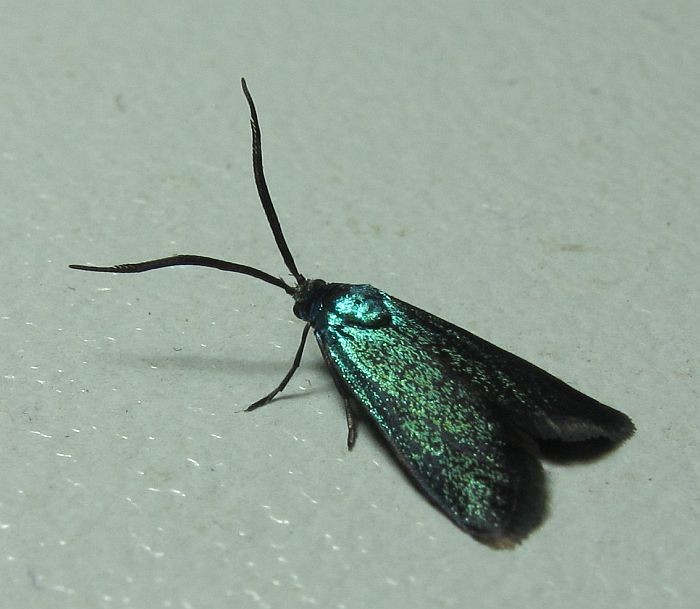
Pollanisus sp. – Forester Moth

Click image to enlarge

Forester Moth - Pollanisus sp.

Forester Moths are small moths, with bright metallic coloration that will flash when viewed from certain angles. They are mainly active during the day and probably use their colours to warn predators like birds of their poisonous nature, which as adults they produce cyanide especially for this purpose. Pollanisus is the largest genus in the family Zygaenidae, with 20 described species (Australian Faunal Directory) that when combined with 9 other family genera currently bring the total number to 43, although many others remain undescribed.

Despite being active during the day, they can also be attracted to light at night, where due to their small size (5-8 mm (1/4”) in head/body length, they may be more easily spotted. In WA there are 4 known Pollanisus species: P. acharon, P. cupreus, P. empyrea and P. nielseni, so presumably the photos above would illustrate one or more of these species.

These moths are not common, but will turn up on certain warm, calm nights between September and April; mostly they visit in ones and twos, but occasionally over a dozen will appear. And being so spectacularly coloured are always a welcome sight.

Their larvae apparently show a preference for Hibbertia spp. (Guinea Flowers) that are very common in the Esperance district in both number and diversity. The caterpillars are hairy and feed only on the upper leaf surface to leave characteristic tracks (Zborowski and Edwards – A Guide to Australian Moths).

01 July 2010

Hippotion scrofa - Hawk Moth

Click image to enlarge


Hawk Moth - Hippotion scrofa

Hark Moths belong to the Sphingidae family and in Australia there are 65 recorded species (Australian Museum), with most occurring in tropical and sub-tropical forested zones where often common. However I have only seen a single species and to date, only a single moth as shown above, so unless secretive, they are far from being common in the southeast of Western Australia, although probably more so in the forested southwest.

Hawk Moths are nectar feeders and like humming-birds, usually hover over flowers when feeding and are credited with the pollination of many plants as they probe tubular flowers with their long proboscis. The rapid wing movements required to hover indicates their relative physical strength and flying capability, which when fuelled with nectar can be considerable.

Hippotion scrofa is found over much of Australia and even overseas making it one of the most widespread of moths. The one above was encountered near Esperance on 24th December, which was a nice Christmas present, but probably coincides with its feeding habits. Like other Hawk Moths, it was a sleek impressive looking insect a little over 3 cm (11/4”) in head/body length.

18 June 2010

Donuca spectabilis – Noctuidae

Click image to enlarge

Donuca spectabilis – Noctuidae

This moth as the name suggests is quite spectacular with its vivid markings and orange body; the head/body length is around 3 cm (little over 1”) and can be seen locally during December and January. Apparently Donuca spectabilis is found throughout Australia (except Tasmania), although all references state the larvae feeds on the Golden Wreath Wattle, Acacia saligna, which many would know is a native of Western Australia, although widely planted as an ornamental and stock fodder tree. So if A. saligna is the only foodplant for the larvae, then presumedly Donuca spectabilis originated in WA. This group of moths is currently under review and this question hopefully will be resolved.

Noctuidae is a large moth family and well represented in Australia. The Australian Faunal Directory lists 428 genera with 1234 species (many being endemic), plus there are numbers of undescribed species. The genus Donuca currently has 6 species. As Acacia saligna (larvae food plant) is particularly common around Esperance, you would expect this moth to be also common, but if it is, then they are not attracted to house lights, as unfortunately only a few moths visit me each year. Perhaps the calcareous coastal belt where this wattle can be rampant, produces higher moth numbers than in non-calcareous heathland.

15 June 2010

Endoxyla didymoplaca – Goat Moth

Click image to enlarge

Goat Moth - Endoxyla didymoplaca

The CSIRO Entomology - Australian Moths Online website has two collections of this moth, both within 15 km (9 miles) north of Esperance, I have encountered it only once, 20 km to the east of the township, so either it is not attracted to lights or is uncommon! To the north of Esperance, at least as far as Salmon Gums (100 km or 62 miles) it has been extensively cleared for agriculture, although after 50 km to the east it is still in its original state, as is much of the coastal zone. This clearance would undoubtedly affect the viability of this species, should its distribution be central to it. The only other alternative, would be if this species main habitat is the mallee environment and these collections (including my own) represent its most southerly distribution.

All three occurrences were in November and similar to the other local Goat Moth, Endoxyla bipustulatus that was recently posted here (see top right-hand column ‘Insects – Moths’ or bottom right-hand column ‘Insects – Moths – Goat Moth 1’). This previous post contains additional information on this group of moths.

The moth photographed above was around 3 cm (little over 1”) in head/body length. If encountered again, I shall post details here.

13 June 2010

Endoxyla bipustulatus – Goat Moth

Click image to enlarge


Goat Moth - Endoxyla bipustulatus

Endoxyla is a member of the family Cossidae, which are renown for their large size and considerable weight. The heaviest moth in the world could well be our Endoxyla macleayi from NSW and southern Queensland, which apparently has an abdomen the size of a small banana, but unfortunately is not often encountered.

These large moths are also called Wood Moths or Carpenter Moths as their larvae bore into eucalypt trunks, where they can do considerable damage if the tree is required for timber; or they will burrow into the roots of certain acacias, particularly in central Australia. The grubs that are the size of your little finger or bigger, are generally known as Witjuti Grubs and have been highly regarded by aborigines for thousands of years. They are also hunted with great determination by many mammals and birds who listen for them and when located will dig them out. The common name of Goat Moth is due to the smelly nature of some grubs of certain species, although adult moths are not likewise affected.

Cossidae according to the Australian Faunal Directory has 20 Australian genera and 87 species, most of which are endemic. The genus Endoxyla is by far the largest with 58 species. Endoxyla bipustulatus has been recorded from Ravensthorpe and Cape Arid, thereby placing Esperance roughly central, but despite this, they are not locally common and if seen at all, is between October and December, even the two recorded collections above were made in November. This timing would coincide with the beginning of warmer weather and a reduction of rainfall, although ground conditions would still be moist and humidity reasonably high.

As Goat Moth larvae usually take 2 and 3 years before they pupate, mass emergence of adult moths are not likely unless their food trees are very numerous, which may reflect their limited numbers in the Esperance region due to a shortage of suitable sized eucalypts. Although with inland mallee regions where there are considerably more eucalypts, it could be a different matter. Anyway, when the larvae do eventually pupate, the newly formed moth will emerge from the trunk, leaving its pupal shell protruding from the tree. Endoxyla bipustulatus is on the smaller end of Cossid moths being around 4 cm or 13/4” in length.

16 April 2010

Moerarchis clathrata - Cloths Moth

Click image to enlarge


Cloths Moth - Moerarchis clathrata

Moths in the Moerarchis genus belong to the Tineidae family that are collectively known as Cloths or Wool Moths, but only a small number of moths in this family are guilty of that offence. The larvae of Moerarchis clathrata feast on the stumps of dead Grasstrees (Xanthorrhoea spp.) and have not the slightest interest in human clothing, so its common name is an unintentional slur on this most attractive small moth (around 1 cm or 3/8” in length).

This species occurs along the south coast of Western Australia, where grasstrees are particularly plentiful in the coastal heath. In the Eastern States where grasstrees are also common, another similar looking Moerarchis species (M. australasiella) occupies this niche. Both have reflective metallic scales, thus making their colours difficult to reproduce with any photographic accuracy, but are most picturesque with the bright orange strongly contrasting with the black, cream and yellow wings.

The Moerarchis clathrata moths are reasonably common and are attracted to house lights after rain during summer and autumn. As adults, they have only a short life as they do not feed, but hopefully will find a mate in order to reproduce in the time available.

29 March 2010

Pterolocera elizabeta - Anthelidae

Click image to enlarge


Pterolocera elizabeta - Anthelidae

The Pterolocera elizabeta male is a striking woolly moth with huge antennae used to track the wingless females. These large antennae are a feature of the Pterolocera genus, although not all species have wingless females. Those of Pterolocera isogama (also from the southern part of WA) do have wings, but to complicate identification the males are similar to Pterolocera elizabeta, although without wing markings and emerge from their cocoon mid-winter. Pterolocera elizabeta on the other hand emerges after rain during late summer and autumn, which is the case above.

This WA species also looks similar to Anthela ferruginosa (once placed in the Pterolocera genus), but this species is apparently restricted to NSW, ACT, Victoria and Tasmania. Another problem taxonomists have had with classifying these moths is they are highly variable in coloration and markings, so it is wise not to be too pedantic in this regard. I have included a caterpillar photograph that I suspect is the larval stage, due to the scruffy hairy nature and markings (particularly the bold vertical stripe on the head). The larvae feed on low bushes and apparently pupate in the ground, their hairs projecting through the cocoon, which if handled can penetrate the skin, then break-off to become very irritating.

Pterolocera elizabeta is about 2 cm (3/4”) in head/body length and apparently prefers the cooler part of the night, which again matches the above moths that appeared around midnight after rain, during February and March. Both were attracted to house lights and if this is a species characteristic, then they are not overly common around the Esperance heathland as only a few have visited.

30 October 2009

Bag-shelter Moth - Ochrogaster lunifer

Click image to enlarge


Bag-shelter Moth - Ochrogaster lunifer

On the mainland, Ochrogaster lunifer is just about Australia wide and because of this wide distribution can be highly variable in color and markings. Amongst moth entomologists there is the suspicion that there may be more than one species represented under the O. lunifer banner. The one photographed above is one of the more unusual and highly spectacular forms, plus the abdomen is horizontally striped with bright orange and black bands, so quite a stunning individual.

The males are around 2.5 cm (1") long and are seen during October and November and unerringly follow the pheromones of the female moths in the sandy heaths around Esperance. They are however only around for a short period, as they have no mouth parts to feed and so die within a few days after they have mated and hopefully started a new generation.


The caterpillars are known as Processionary Caterpillars and move head to tail in line from one food source to another.  As a word of warning, the hairs on the caterpillar, their silken nests and those on the tail end of the adults can cause skin rashes, so should be avoided, but they are nevertheless well worth a prolonged gander.


August 2013 update
Two photos added and two old ones removed.

05 October 2009

Dichromodes confluaria

Click image to enlarge


Dichromodes confluaria - Geometridae

A distinctively marked delta winged moth that is common to the Esperance region. It belongs to the Geometridae family whose larvae are commonly known as Loopers or Inchworms based on their looping locomotion, when they bring their rear end to the head end, thereby creating a loop with their body. It also belongs to the Oenochrominae subfamily that are well represented in Western Australia with numerous family members relying on the flora family Myrtaceae for sustenance. Myrtaceae includes Eucalyptus, Melaleuca and a vast array of other genera, most of which are very common here, as are the invertebrates (like this moth) that depend upon them.

Dichromodes confluaria is attracted to house lights and can often be found clinging to windows on calm, humid and not too cold evenings, particularly during August and September. There are males and females in the photographs above, the males have the attractive comb-like (pectinate) antennae, whilst the females have simple whip-like ones. Size wise, the head/body length is between 1.5 and 2 cm or nearly 3/4", although recently I have come across several closer to 1 cm, which gives them a considerable size range. Such differences also apply to people and in some instances to the same extent, so we should be open to such events.