Showing posts with label Insects - Beetles. Show all posts

19 October 2013

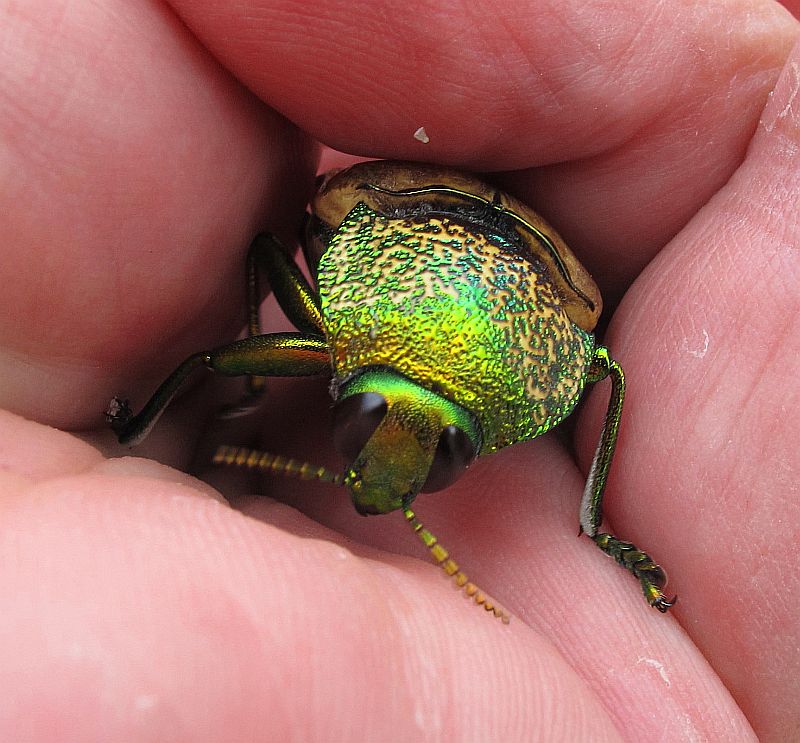
Temognatha murrayi - Blackbanded Jewel Beetle (6)

Click image to enlarge

Temognatha murrayi - Blackbanded Jewel Beetle (6)

This Jewel Beetle is the sixth posted here from the mass occurrence around Lake Tay in February 2013 (see earlier posts for details). It was quite common and well represented amongst other species feeding on the blossom of flowering eucalypts, with a number mating during the process. 

I found this beetle reasonably cooperative, permitting me to pick them up and although initially wriggling, soon settling down and in no hurry to fly off. Their size was around 4 cm (13/4”) in length. 

Temognatha murrayi is a WA endemic with most records south of a line from Geraldton to east of Kalgoorlie, but excluding the southwest corner of the State. It has also been recorded as far north as Marble Bar, so likely to exist in the intervening vast and largely uninhabited region. 

The problem obtaining good records of these large Jewel Beetles is they mostly occur at the hottest time of the year in remote regions, plus are apparently very fickle by appearing in large numbers some years, but none in others. Therefore you really need to be in the right place at the right time, which combined with the harsh environment and few people in those areas at that time of year, sightings are usually a case of accidental encounter.

Most of the larger beetles in the genus Temognatha were split from the Stigmodera genus. However both are prominent members of Buprestidae, the Jewel Beetle family. 

My thanks to Kim Pullen of the Australian National Insect Collection, CSIRO Ecosystem Sciences who kindly confirmed the identity this species. 


15 September 2013

Temognatha obscuripennis – Large Jewel Beetle 5

Click image to enlarge

Temognatha obscuripennis – Large Jewel Beetle 5

This is another large Jewel Beetle seen in a mass gathering near Lake Tay in February 2013 (see earlier Large Jewel Beetle 1-4 posts for details). Most of the gathered beetles were feeding from eucalyptus blossom, as was this species although one beetle was found on Choretrum glomeratum the Common Sour Bush, which may be a misidentification by the beetle, mistaking the white floral display for that of a eucalypt. 

This beetle was 3-4 cm (11/2”) in length, but unlike most others did not quickly fly away when released and just wandered over my hand and up my arm, even when placed next to the plant where I initially found it. It literally had to be plucked off my person and placed onto the shrub, thus making it the most docile of all Jewel Beetles seen that day. 

Temognatha obscuripennis (previously known as Stigmodera obscuripennis) has its most easterly recordings from Albany to Lake Grace and the Hyden district, with the most northerly being from Wiluna (central WA). Therefore having it occur at Lake Tay, which is around 200 km (125 miles) further east is a range extension, although due to the extensive undeveloped mallee habitat of the region is not an unexpected discovery. 

Another similar looking (black and red) Jewel Beetle (Temognatha bonvouloiri) whose distribution closely overlaps T. obscuripennis can make identification difficult. Fortunately I also encountered the other beetle in the Lake Tay region, so could provide evidence of both species to Kim Pullen of the Australian National Insect Collection, CSIRO Ecosystem Sciences, who kindly identified them for me. 

Apparently T. obscuripennis is “shorter, broader and more convex than T. bonvouloiri.” Whereas T. bonvouloiri is “more elongate than T. obscuripennis; also has notch in end of each elytron.” Length and colour pattern are otherwise very similar. 

The genus Temognatha belongs to the Buprestidae family.

15 July 2013

Temognatha duponti - Large Jewel Beetle 4

Click image to enlarge

Temognatha duponti - Large Jewel Beetle 4 

This is another of the large Jewel Beetles seen at a mass sighting near Lake Tay during February 2013, of which further details are available at http://esperancewildlife.blogspot.com.au/2013/05/temognatha-chevrolati-large-jewel.html and http://esperancewildlife.blogspot.com.au/2013/05/temognatha-heros-large-jewel-beetles.html.  This specific species was occasionally found in company with different species, but also encountered in small groups on their own. 

The most interesting aspect of Temognatha duponti was their temperament, which was aggressive and bombastic, and if there ever was a barrel chested beetle that won’t take crap from anyone, it would be this one. This attitude was reinforced by a solid bite to fingers when they got in the way whilst trying to restrain them, hence my side on grip. 

Temognatha duponti was also one of the larger beetles (5-6 cm or a little over 2” in length) and certainly the most robust that complimented their head down, bulldozing activity. Some beetles had a couple of variable length yellow/orange stripes on each hardened forewing (elytron), although most did not, however all had a black head segment (pronotum) and a dark maroon body (elytra). 

This species is mainly recorded from mallee environments to the south of Southern Cross (340 km or 210 miles ENE of Perth), but is also known from the Yorke Peninsula in SA. It is therefore presumed to occur in mallee regions between these sites, although being a poorly collected area has apparently not as yet been officially recorded. 

The 85 largely Australian species in the Temognatha genus, belong to Buprestidae the much larger worldwide Jewel Beetle family. 

My thanks to Kim Pullen of the Australian National Insect Collection, CSIRO Ecosystem Sciences who kindly confirmed the identity this species. 


23 June 2013

Temognatha pictipes - Large Jewel Beetle 3

Click image to enlarge

Temognatha pictipes - Large Jewel Beetle 3 

Temognatha pictipes was another of the large Jewel Beetles (4 cm or 11/2” in length) that made up the mass sighting at Lake Tay during February 2013 (see http://esperancewildlife.blogspot.com.au/2013/05/temognatha-chevrolati-large-jewel.html and http://esperancewildlife.blogspot.com.au/2013/05/temognatha-heros-large-jewel-beetles.html for more detail). 

This colourful beetle was quite docile, although after taking a quick look around at the end of my fingers, would take off for a less stressful place with other beetles amongst the eucalypt blossom. 

Fauna records indicate this species is endemic to WA, but is very widespread with far-flung discoveries at Perth, Marble Bar and another on the Nullarbor Plain, NW of Eucla. However most records are within an area from Coolgardie to north of Salmon Gums, then west to the Lake Tay region and further west to Lake King, before heading NW to Kondinin (west of Hyden) and eventually ending at Southern Cross (west of Coolgardie). 

Within the central area above of the most commonly recorded locations, is a region seldom visited as there are few tracks and no bitumen roads. I would think that this wild mallee area of over 600 square kilometres would be the stronghold of Temognatha pictipes and many other large Jewel Beetles. 

The genus Temognatha has previously been known as Stigmodera and Themognatha and belongs to the Buprestidae family. 

My thanks to Kim Pullen of the Australian National Insect Collection, CSIRO Ecosystem Sciences who kindly confirmed the identity this species.

23 May 2013

Temognatha chevrolati – Large Jewel Beetles 2

Click image to enlarge

Temognatha chevrolati – Large Jewel Beetles 2

These spectacular iridescent beetles were in their hundreds when I encountered them feeding and mating in flowering Eucalyptus perangusta, primarily around Lake Tay 140 km (85 miles) NW of Esperance and in company with many other large Jewel Beetle species. 

These mass occurrences are recorded happening spasmodically across the country in mallee country during the hottest months of the year (January to March), often years apart and I just happened to be in the right place at the right time. I had been investigating on a monthly basis the vegetation of the Lake Tay region and only encountered these large Jewel Beetles during the month of February, interestingly none were observed the month before or after. 

Temognatha chevrolati are around 5 cm (2”) in length and were the most plentiful of the larger Jewel Beetle species; they were also the most active and alert too, quickly taking flight the moment the camera was pointed in their direction, only mating couples were placid enough to be approached. Because of this skittishness (although not aggressive and with no attempt to bite), I was forced to grab and hold individuals to photograph and that is why there is usually a finger or thumb being used as a restraint in the above photographs. 

When released, almost immediately up would go the hardened wings of the elytra and with the frantic beating of the membranous wings beneath, they would with a monstrous buzzing sound take flight. I might add that this action although appearing laboured, was always faster than I could click the shutter to record it digitally. They would seldom fly far, only to suddenly plummet out of sight into more eucalypt blossom. 

Temognatha chevrolati is only found in WA, with Hyden and Lake Grace being central to their distribution; Lake Tay is around 120 km (75 miles) further east and as this region is more remote and largely inaccessible, would probably also be an important stronghold for this species. 

The genus Temognatha has previously been known as Stigmodera and Themognatha and belongs to the Buprestidae family. 


My thanks to Kim Pullen of the Australian National Insect Collection, CSIRO Ecosystem Sciences who kindly confirmed the identity this species.

10 May 2013

Temognatha heros – Large Jewel Beetles

Click image to enlarge

Temognatha heros – Large Jewel Beetle

The genus Temognatha contains the larger Jewel Beetles with the species Temognatha heros being one of the largest. However there are over 85 species with most being endemic to Australia and many of these found only in WA. These beetles are encountered during warm to hot weather, commonly between January and March and often in mallee regions where they emerge from the roots of trees and during a brief mating and feeding spree, lay their eggs around the bowls of trees especially the mallee eucalypts. 

The larvae after they hatch, burrow into the roots where they will spend many years feeding and growing (some for over 15 years) to eventually emerge (often en masse) to complete the cycle. It is recorded that in some years, these large beetles can be found not only in huge numbers, but also feeding together in massive mixed colonies. I was very fortunate in mid-February 2013 to happen upon such a mass gathering around Lake Tay (140 km or 85 miles NW of Esperance) where hundreds of beetles from eight different Temognatha species were seen feeding together. 

I only saw a single Temognatha heros beetle, but it was enormous easily dwarfing the other large species and upon measuring where it had been on my hand, it was around 8 cm (little over 3”) in length, only bettered in size by a few exceptional beetles of tropical forests. However its large size was not a hindrance to flight, as suddenly it lifted its hardened outer wings (elytra) and with these jockey-like hardened wings held erect, took flight and loudly buzzed off as if powered by an undersized 2-stroke engine. 

Temognatha heros occurs throughout most of WA, although in the southern mallee regions, is also recorded across SA into NSW and Victoria. 

The genus Temognatha has previously been known as Stigmodera and Themognatha and belongs to the Buprestidae family. 

My thanks to Kim Pullen of the Australian National Insect Collection, CSIRO Ecosystem Sciences who kindly confirmed the identity this species. 


21 March 2013

Bolborhachium hollowayi

Click image to enlarge

 Bolborhachium hollowayi

This handsome little orange/brown beetle belongs to a group of 25 mainly Australian species in the genus Bolborhachium, the majority of which occur in WA and many of these primarily along the southern coastal fringe. They are a poorly known group of largely subterranean insects whose larvae apparently feed on fungi and/or humus. The female digs a deep vertical burrow where she constructs an egg chamber that is stocked with food for the larvae.

The male of this species is a little over 1 cm (1/2”) in length and identified by the ornamentation on its head and prothorax (large shield behind the head), with each species sporting a different appendage. Bolborhachium hollowayi has a single horn, others have more and/or different shapes. The females have no appendages, which apparently can make matching the male to the female of the same species somewhat difficult.

They are supposed to be attracted to house lights at night, which is what happened to the few I have photographed, but these were no more than a small handful over several years and in the case of Bolborhachium hollowayi, has only been seen during October and March. So if these beetles are strongly attracted to house lights, then they are not common locally (20 km or 12.5 miles east of Esperance) despite Bolborhachium hollowayi being first named and collected only 35 km (22 miles) west of Esperance.

As Bolborhachium largely inhabit the coastal fringe, it might reflect a preference of these insects for alkaline habitats and so largely exclude my main observation area sited on non-calcareous soils, but bordering a calcareous zone. The alkaline environment is also more extensive in the region where was originally recorded than here.

Bolborhachium is a member of the Bolboceratidae family, although was originally placed in Geotrupidae.

My thanks to Kim Pullen of the Australian National Insect Collection, CSIRO Ecosystem Sciences who very kindly identified this species.

31 January 2013

Flower Scarab - Aphanesthes succinea

Click image to enlarge

Flower Scarab - Aphanesthes succinea

These beetles as their common name suggests, feed on flower nectar and pollen. There are 3 Aphanesthes species (Australian Faunal Dictionary) and probably all including A. succinea are exceptional fliers and able to tightly twist and turn at will, plus adjust their speed to almost a hover. They do these manoeuvres with a loud buzzing sound due to their elytra’s (hardened outer forewings) being fused together over the more flexible hindwings that are used for flight. 

The above species like many invertebrates, is poorly collected and in this instance with only 11 known records. All from WA with most in the Kalgoorlie/Coolgardie region, but also from around Perth, Hyden and 1 in the Pilbara. So those photographed above and encountered near Esperance in deep non-calcareous sandy soil (heathland community) is a new sighting, although not unexpected. 

I have seen them on several occasions, although only during January and February when apparent females arrive to lay their eggs in/on buried rotting timber that is eaten by the larvae.  They locate the required area with little effort, possibly aided by imprinting, odor or some other location recognition, as several beetles will arrive one after the other and bury themselves in close proximity to each other.

As the adults are nectar feeders they are most active during the day, but I have not noticed them other than when they arrive in the Banksia speciosa habitat to lay their eggs, which they did in two communal egg-laying sites about 5 metres apart. They grow to around 1.5 cm (little over 1/2”) in length 

The Aphanesthes genus is a member of the Scarabaeidae family and the Cetoniinae subfamily. 

Regarding identification, my special thanks to Kim Pullen from the Australian National Insect Collection, CSIRO Ecosystem Sciences.